
Staff Augmentation Vs Managed Services: Choosing The Right IT Support Model



Table of Contents
Internal IT is clearing password resets before payroll, but the cloud migration keeps slipping and endpoint rollout tickets are stacking up. That’s when staff augmentation vs managed services becomes practical, not theoretical.
The managed services vs staff augmentation decision comes down to capacity, accountability, predictable support costs, and how much pressure your team can absorb. Even with AI changing work, 87% of surveyed executives believe employees are more likely to be augmented than replaced by generative AI.
Alma Trevino, Office Manager at Hardin Technology, notes: “Start by mapping the work, tickets, project tasks, security monitoring, and approvals, then decide what needs extra hands and what needs outside ownership.”
Staff Augmentation Vs Managed Services
A project manager needs a migration specialist for Microsoft 365, but the help desk is buried in access requests and laptop setup. Augmented IT help adds skilled people under your team’s direction for a short-term project or a specific gap. Managed IT support shifts recurring ownership of help desk, monitoring, maintenance, backups, security, and follow-through to an outside IT partner.
Security staffing gaps also carry real business risk. IBM reports organizations with high-level security skills shortages faced an average breach cost of USD 5.74 million, compared to USD 3.98 million for lower-level shortages.
-
Ownership of outcomes: Added staff completes assigned work under your direction; outsourced IT coverage owns recurring support workflows.
-
Speed to add skills: We can tailor staff support to a migration, rollout, network change, or defined project scope without forcing a long-term hire.
-
Daily support coverage: Our Complete Support Plan covers onsite and remote support under one predictable monthly cost, so daily tickets don’t pull project leads away from planned work.
-
Cost predictability: Covered upgrades, replacements, and additions help avoid hourly billing surprises for supported work.
Managed Services Vs Staff Augmentation
Once the model is clear, the next question is who carries the recurring load. If your team has a solid plan but lacks a firewall specialist for two weeks, augmented staffing fits. If tickets, patching, backup checks, endpoint alerts, and server monitoring keep cycling back, the managed service model gives that work an owner.
Think about a controller waiting on invoice system access approvals while IT is troubleshooting a firewall alert and imaging laptops for new hires. Payroll still needs to run. If those interruptions repeat every week, outsourced IT support is solving a workflow problem, not just a staffing problem.
The next step is to turn the service choice into an operational capability plan. Map help desk support, backup recovery, endpoint protection, cloud administration.
Cybersecurity often drives that decision, with 60% of respondents in a recent study naming it the top challenge that led them to work with an MSP. In our Complete Support Plan, proactive endpoint protection, managed firewall protection, hybrid backup, and server alerts are tied to daily support coverage, so alerts, failed backups, and repeat device issues don’t sit in someone’s inbox.
Staff Augmentation Or Managed Services For Project Pressure
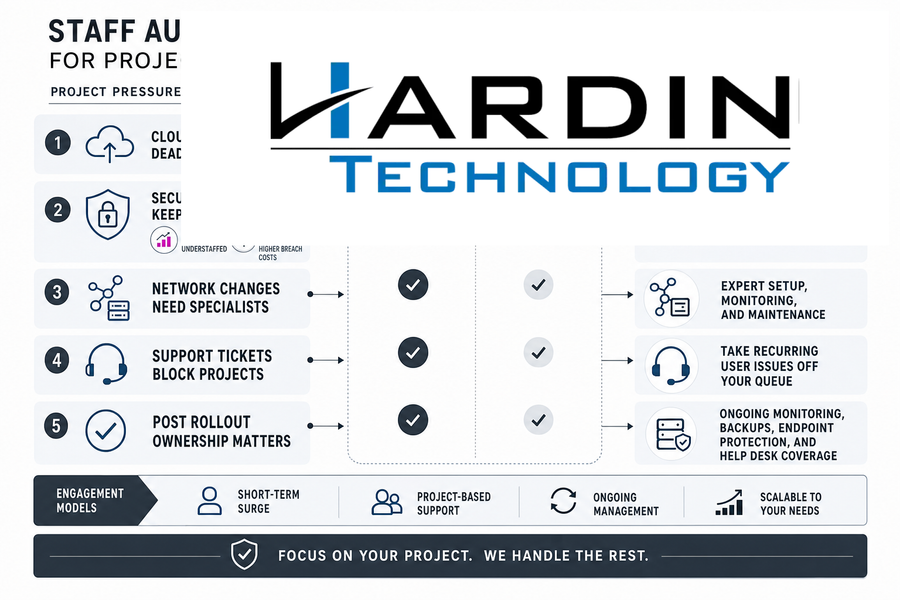
Project pressure usually shows up as missed handoffs. A VoIP rollout waits on firewall changes, a cloud migration stalls during mailbox testing, or server maintenance gets postponed because ticket volume won’t drop.
-
Cloud migration deadlines slipping: Added IT capacity works when your internal lead owns the plan but needs Microsoft or cloud services expertise to finish configuration, testing, and user cutover.
-
Security work keeps waiting: Understaffed security teams increased 26% and saw an average of USD $1.76 million in higher breach costs than organizations with low-level or no security staffing issues.
-
Network changes need specialists: Our Microsoft-certified systems engineers support setup, monitoring, and maintenance when routing, switching, or server dependencies affect payroll, invoicing, file access, or customer-facing applications.
-
Support tickets block projects: Managed support protects project time by taking recurring user issues off the internal queue.
-
Post-rollout ownership matters: After go-live, monitoring, backups, endpoint protection, and help desk coverage keep the new system usable.
Explore IT Service Models
Managed Services And Staff Augmentation In Daily IT Support
At 9:15 a.m., a new hire can’t access email, an endpoint alert hits, and accounting opens a ticket because the invoice folder won’t sync. That pattern tells you more than a staffing chart.
Our local help desk benchmarks include average remote response under 1 hour, on-site support within 4 hours, over 95% first-contact resolution, and a 50-60% reduction in recurring IT issues after 3 months. Those numbers matter because slow response turns small access, device, and file problems into blocked work.
-
Ticket volume patterns: Spikes around onboarding, payroll, or month-end close may need short-term help.
-
Recurring issue trends: Repeated printer, login, or file access tickets point to process fixes, not just more people answering the same questions.
-
Security alert handling: Severe or high-level staffing shortages were tied to USD 5.74 million in breach costs, versus USD 3.98 million for low or no shortages.
-
User access delays: Waiting on account approvals, permission changes, or application access slows onboarding.
-
Backup recovery needs: Backup checks need clear ownership before a deleted file, failed server, or ransomware event turns into a scramble.
Changing support models affects workflows, budgets, and internal roles, so start with evidence:
-
Review 30 to 60 days of ticket categories if available.
-
Separate project backlog from recurring support work.
-
Identify systems that need after-hours monitoring.
-
Document temporary skill gaps.
-
Decide which outcomes need outside ownership.
Choose Your IT Support Model
Compare staff augmentation and managed services with Hardin Technology so your team can close gaps without losing momentum.
Staff Augmentation With Managed Services For Better IT Planning
This is not always an either-or call. You can bring in added IT capacity for a server refresh while using outsourced support for tickets, backup checks, firewall monitoring, endpoint security, and consulting. IT consulting can help maximize ROI by guiding decisions about when to hire, augment, outsource, replace hardware, improve backups, or standardize support.
-
Define the work type. Separate one-time project tasks from recurring operations like patching, account approvals, and backup verification.
-
Assign clear operational ownership. Decide who owns the deadline, user communication, and support after the change goes live.
-
Protect support response times. If the rollout team is also closing help desk tickets, project dates slip.
-
Plan security coverage early. With 60% of respondents citing cybersecurity as the top reason for working with an MSP, security ownership belongs in the plan before an alert hits.
-
Budget for steady operations. IBM reports USD 5.74 million average breach cost for high-level security skill shortages, compared with USD 3.98 million for lower-level shortages.
Choosing Managed Services Or Staff Augmentation With Hardin Technology
The right support model depends on the real pain in front of you: a temporary skills gap, an overloaded help desk, a delayed rollout, recurring security risk, or the need for predictable ongoing support. Start with the workload.
We can help you review support gaps, project timelines, risk areas, and internal capacity, then match the work to tailored staff augmentation, complete IT outsourcing, local help desk support, network support, security, backup, Microsoft and cloud services, or strategic IT guidance. If predictable coverage is the priority, our Complete Support Plan provides full IT coverage under one monthly cost with no hidden fees or nickel-and-diming, so password resets before payroll don’t keep pushing bigger IT work off schedule.